Advanced Shopify Store Marketing Strategies: How High-Growth Brands Scale with AI, Omnichannel Funnels, and Personalization
The ecommerce landscape has never been more competitive. With over 4.5 million Shopify stores globally and customer expectations at an all-time high, high-revenue brands need sophisticated marketing strategies to maintain their competitive edge and drive sustainable growth. Today’s consumers demand seamless experiences, hyper-personalized interactions, and value-driven relationships that extend far beyond transactional exchanges.
Why Modern Shopify Store Marketing Strategies Matter More Than Ever
The digital commerce ecosystem has evolved dramatically. What worked for Shopify stores just two years ago now falls short in a marketplace where AI-driven personalization, omnichannel integration, and data-driven customer journeys have become baseline expectations rather than competitive advantages.
High-growth brands generating $500K to $10M in revenue face unique challenges. They must scale efficiently while maintaining the personalized touch that built their success. They need systems that can handle increased complexity without sacrificing conversion rates or customer lifetime value.
Successful Shopify store marketing strategies now require a sophisticated understanding of customer behavior, advanced automation capabilities, and the ability to create cohesive experiences across multiple touchpoints. Brands that master these elements consistently outperform competitors by 30-40% in key metrics like customer acquisition cost, average order value, and retention rates.
The Three Pillars of Modern Shopify Marketing: Building Your Foundation
Effective Shopify store marketing strategies rest on three fundamental pillars that work synergistically to drive growth: owned channels, earned media, and paid advertising. Understanding how to leverage each pillar while creating seamless integration between them separates high-performing brands from the competition.
Owned Channels: Your Marketing Foundation
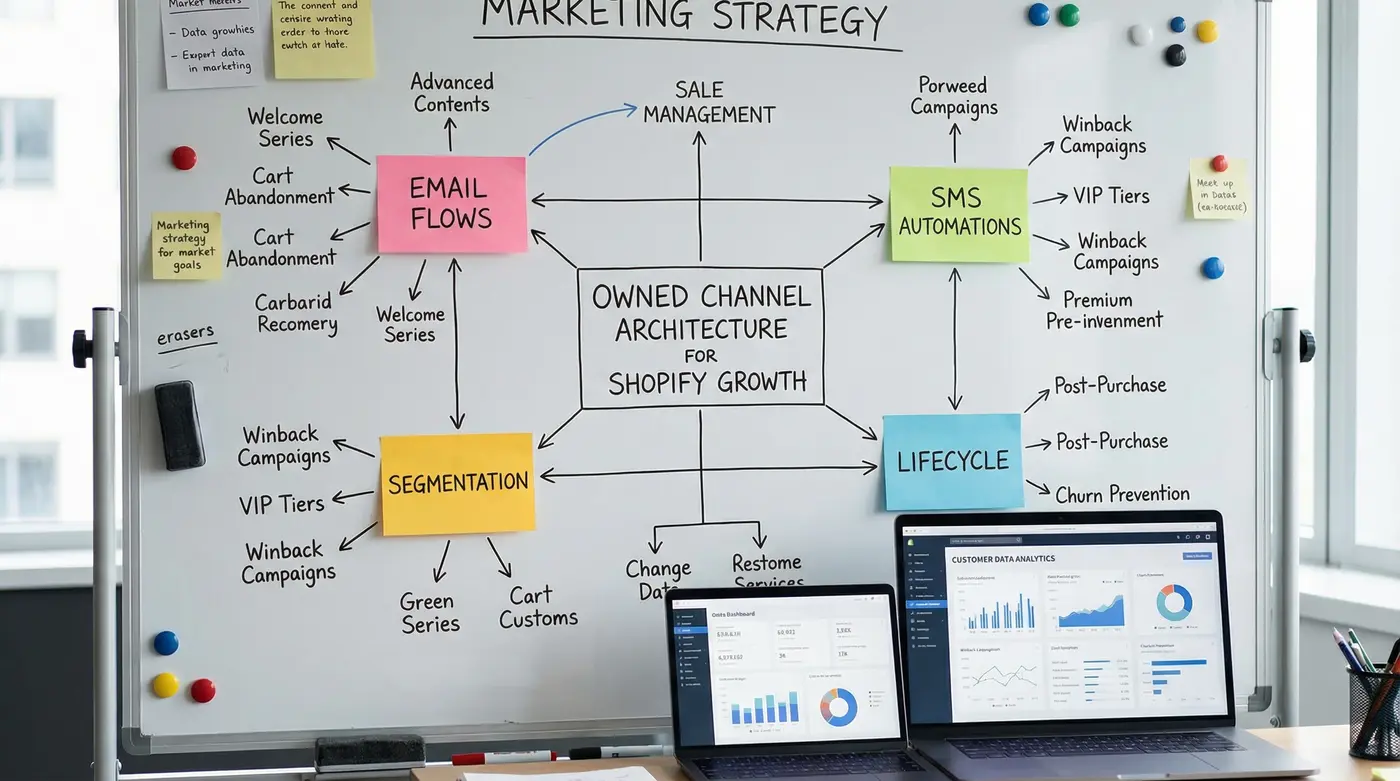
Owned channels represent the digital real estate you control completely. Your Shopify store, email lists, SMS subscribers, blog content, and even product packaging create opportunities for direct customer engagement without ongoing media costs.
Email marketing remains the cornerstone of owned channel strategy, delivering an average ROI of $42 for every dollar spent. However, modern email marketing goes far beyond basic newsletters. High-growth brands implement sophisticated automation sequences including welcome series, cart abandonment flows, post-purchase upsells, and win-back campaigns that nurture customers throughout their entire lifecycle.
SMS marketing has emerged as a powerful complement to email, offering immediate reach and higher open rates. When integrated properly with email campaigns, SMS can increase overall campaign effectiveness by 25-30%.
Earned Media: Amplifying Authentic Advocacy
Earned media encompasses the authentic endorsements, user-generated content, reviews, and organic social mentions that build credibility and trust. In an era where consumers increasingly distrust traditional advertising, earned media provides the social proof that drives purchasing decisions.
User-generated content campaigns, strategic influencer partnerships, and robust review management systems create sustainable growth engines that compound over time. Brands that excel at earned media often see customer acquisition costs 50% lower than those relying primarily on paid advertising.
Paid Channels: Scaling What Works
Paid advertising serves as the accelerant for proven strategies. Rather than hoping for organic discovery, paid channels allow you to reach specific audiences with targeted messaging at scale. The key lies in using paid advertising to amplify already-successful owned and earned media initiatives.
Modern paid advertising strategies extend beyond basic Facebook and Google ads to include YouTube, TikTok, Pinterest, and emerging platforms where your target audience spends time. Cross-platform attribution and unified campaign management ensure consistent messaging and optimal budget allocation.
Leveraging AI for Hyper-Personalization at Scale
Artificial intelligence has transformed from a nice-to-have feature into a necessity for competitive Shopify store marketing strategies. AI enables the kind of individualized experiences that were previously impossible at scale, driving conversion rate improvements of 15-25% for brands that implement it effectively.
Real-Time Product Recommendations
Modern AI recommendation engines go far beyond customers who bought this also bought. Advanced systems analyze browsing behavior, purchase history, seasonal patterns, and even external factors like weather or local events to suggest products with uncanny relevance.
These systems learn continuously, improving their accuracy with each interaction. Brands using advanced recommendation engines typically see 20-30% increases in average order value and significant improvements in customer satisfaction scores.
Dynamic Pricing and Inventory Optimization
AI-driven dynamic pricing adjusts product prices based on demand, inventory levels, competitor pricing, and customer behavior patterns. This approach maximizes revenue while maintaining competitive positioning, particularly important for brands with extensive product catalogs.
Inventory optimization algorithms predict demand patterns, seasonal fluctuations, and product lifecycle stages to minimize stockouts and overstock situations. This directly impacts cash flow and customer satisfaction.
Predictive Customer Journey Mapping
Perhaps the most powerful application of AI in Shopify store marketing strategies involves predicting customer behavior and proactively addressing their needs. Predictive analytics can identify customers likely to churn, prospects ready to purchase, and opportunities for upselling or cross-selling.
These insights enable proactive customer service, targeted retention campaigns, and personalized offers that arrive at precisely the right moment in the customer journey.
Creating Unified Omnichannel Commerce Experiences
Today’s customers expect seamless experiences across all touchpoints. They might discover your brand on social media, research products on your website, make purchases through your mobile app, and pick up orders in-store. Each interaction should feel connected and consistent.
Inventory and Order Management Integration
True omnichannel experiences require real-time inventory synchronization across all sales channels. Customers should see accurate availability whether they’re shopping online, in-store, or through social commerce platforms.
Order management systems must handle complex scenarios like buy-online-pickup-in-store, ship-from-store fulfillment, and seamless returns across channels. This infrastructure complexity requires careful planning but delivers significant competitive advantages.
Unified Customer Profiles and Data Management
Customer data must flow seamlessly between all touchpoints to enable personalized experiences. When a customer browses products on your mobile app, that behavior should inform the email campaigns they receive and the recommendations they see on your website.
Advanced customer data platforms aggregate behavioral data, purchase history, support interactions, and preference information to create comprehensive profiles that power personalization across all channels.
Cross-Channel Attribution and Analytics
Understanding which channels drive conversions and how customers move between touchpoints requires sophisticated attribution modeling. Modern analytics platforms track customer journeys across devices and channels, providing insights that inform budget allocation and strategy optimization.
Conversion Optimization Tactics That Drive Results
While traffic generation often receives the most attention, conversion optimization delivers the highest ROI for most Shopify store marketing strategies. Small improvements in conversion rates compound dramatically over time, especially for high-traffic stores.
Strategic Product Bundling and Upselling
Product bundling increases average order value while providing genuine value to customers. Successful bundling strategies identify complementary products, create compelling value propositions, and use scarcity or limited-time offers to drive urgency.
One-click upsells and cross-sells at strategic points in the customer journey can increase revenue per visitor by 10-30%. The key lies in relevance and timing rather than aggressive promotion.

Social Proof and Trust Signals
Customer reviews, ratings, user-generated content, and trust badges significantly impact conversion rates. However, simply displaying reviews isn’t enough. Strategic review management, response protocols, and integration with product pages create comprehensive trust-building systems.
Influencer partnerships and celebrity endorsements provide powerful social proof, particularly for lifestyle and luxury brands. These partnerships work best when they feel authentic and align with brand values.
Advanced Checkout Optimization
Checkout abandonment remains a significant challenge, with average rates exceeding 70% across all industries. Modern checkout optimization involves reducing friction, offering multiple payment options, providing transparent shipping costs, and implementing intelligent cart recovery sequences.
Guest checkout options, auto-fill capabilities, and mobile-optimized experiences address common abandonment triggers. Post-purchase upsells and immediate email sequences maximize value from completed transactions.
Marketing Automation for Scalable Growth
Automation enables high-growth brands to deliver personalized experiences at scale without proportional increases in labor costs. Effective sales funnel optimization tips focus on creating systems that nurture prospects and customers throughout their entire lifecycle.
Email and SMS Flow Architecture
Sophisticated automation flows go far beyond basic welcome sequences. Modern email marketing includes behavioral triggers, dynamic content, and advanced segmentation that delivers the right message at the optimal time.
SMS automation complements email campaigns with immediate, high-impact touchpoints. Integration between email and SMS ensures consistent messaging while respecting customer communication preferences.
Retargeting and Cross-Channel Remarketing
Advanced retargeting strategies use customer behavior data to create highly relevant ad experiences across multiple platforms. Dynamic product ads, lookalike audiences, and sequential messaging create compelling reasons for prospects to return and complete purchases.
Cross-device tracking and unified customer profiles ensure retargeting efforts remain consistent and relevant regardless of how customers interact with your brand.
CRM Integration and Lead Scoring
Customer relationship management systems integrated with Shopify enable sophisticated lead scoring, sales pipeline management, and customer lifecycle tracking. This integration proves particularly valuable for high-ticket items and B2B sales processes.
Automated lead scoring identifies the most promising prospects, enabling sales teams to focus their efforts where they’ll have the greatest impact. Solutions like CRM integrations enhance this process.
Building Brand Loyalty Through Values and Sustainability
Modern consumers, particularly younger demographics, make purchasing decisions based on brand values and sustainability practices. Authentic commitment to social and environmental causes creates emotional connections that drive long-term loyalty.
Transparency and Authentic Communication
Transparency in sourcing, manufacturing, and business practices builds trust and differentiates brands in crowded markets. Supply chain transparency, ingredient sourcing information, and honest communication about challenges create authentic brand narratives.
Sustainability Initiatives and Impact Measurement
Sustainability programs must go beyond marketing claims to include measurable impact and continuous improvement. Carbon offset programs, sustainable packaging, and ethical sourcing practices appeal to environmentally conscious consumers willing to pay premium prices.
Impact measurement and reporting demonstrate genuine commitment while providing content for marketing campaigns and customer communications.
Category-Specific Marketing Approaches
Different product categories require tailored marketing strategies that align with customer behavior patterns and purchase decision processes.
Convenience Products
Convenience products like consumables and everyday essentials benefit from subscription models, bulk purchasing incentives, and automated reordering systems. Marketing focuses on habit formation and reducing purchase friction.
Shopping Products
Shopping products require extensive comparison information, detailed specifications, and comprehensive review systems. Marketing emphasizes education, comparison tools, and expert recommendations.
Specialty and Luxury Products
Specialty products leverage exclusivity, craftsmanship, and brand heritage. Marketing strategies emphasize scarcity, personalization, and exceptional customer service experiences.
Essential Technology Stack for Modern Shopify Marketing
Successful implementation of advanced Shopify store marketing strategies requires carefully selected technology platforms that integrate seamlessly and scale effectively.
Core Platform Integrations
Email marketing platforms like Klaviyo provide sophisticated automation and segmentation capabilities. Customer support platforms such as Gorgias integrate with Shopify to provide comprehensive customer service experiences. Analytics platforms including Google Analytics 4 and specialized ecommerce analytics tools provide the insights necessary for optimization.
AI and Personalization Tools
Personalization engines, recommendation systems, and AI-powered customer service tools enhance customer experiences while reducing operational overhead. These tools integrate with existing Shopify installations to provide advanced capabilities without complex technical implementations. Advanced funnel systems such as those described in AI funnel tools can support scaling.
Measuring Success: Key Performance Indicators and Optimization
Effective measurement focuses on metrics that directly correlate with business growth and profitability. While vanity metrics might look impressive, actionable insights come from understanding customer lifetime value, acquisition costs, and conversion funnel performance.
Revenue-Focused Metrics
Customer lifetime value, average order value, and repeat purchase rates provide insights into long-term business health. These metrics guide strategic decisions about customer acquisition spending and retention investments.
Operational Efficiency Indicators
Conversion rates, cart abandonment rates, and customer acquisition costs indicate operational efficiency and marketing effectiveness. Regular monitoring and optimization of these metrics drive sustainable growth.
Preparing for Continued Evolution
The ecommerce landscape continues evolving rapidly. Successful brands build flexible systems that adapt to new technologies, changing customer expectations, and emerging marketing channels.
Investment in data infrastructure, team training, and technology partnerships positions brands for continued success as the market evolves. Regular strategy reviews and performance assessments ensure marketing efforts remain aligned with business objectives.
Taking Action on Advanced Shopify Marketing Strategies
Implementing sophisticated Shopify store marketing strategies requires expertise, time, and careful coordination across multiple systems and channels. While the potential for growth is significant, the complexity can overwhelm internal teams already focused on day-to-day operations.
High-growth brands often benefit from partnering with specialized agencies that understand the nuances of ecommerce marketing, automation implementation, and performance optimization. The right partnership can accelerate implementation timelines while ensuring strategies align with business objectives and deliver measurable results.
Ready to transform your Shopify store’s marketing performance? Professional guidance can help you navigate the complexity of modern ecommerce marketing while focusing your internal team on what they do best. Contact our team to discuss how advanced marketing strategies can double your growth in the next 12 months. Solutions such as AI operations automation can support scaling efforts.