The Complete Guide to Marketing Automation Tools for Small Business: Build Systems That Scale
Small businesses today face an unprecedented challenge: competing with larger enterprises while managing limited resources. The solution lies in smart implementation of marketing automation tools for small business that can transform how you capture leads, nurture prospects, and convert customers at scale.
As a digital marketing agency that has helped hundreds of businesses streamline their operations, we’ve seen firsthand how the right automation stack can double growth within 12 months. This comprehensive guide will walk you through everything you need to know about selecting, implementing, and optimizing marketing automation tools that actually deliver results.
Why Marketing Automation is Essential for Small Businesses Scaling in 2026
The landscape of small business marketing has fundamentally shifted. Customers expect personalized experiences across multiple touchpoints, while business owners need to maximize efficiency without sacrificing quality. Marketing automation bridges this gap by enabling sophisticated customer journeys that would otherwise require a team of dedicated specialists.
Consider this: a properly configured automation system can save business owners 5-10 hours per week while increasing lead conversion rates by 30-50%. For a business generating $500K annually, this translates to significant revenue growth and operational freedom.
The core benefits of implementing automation for small businesses include:
Time Savings and Efficiency
Automated workflows handle repetitive tasks like lead capture, follow-up sequences, appointment scheduling, and customer onboarding. This frees up valuable time for strategic activities that directly impact growth.
Increased Client Capacity
With automation handling routine communications and processes, small businesses can serve more customers without proportionally increasing overhead costs.
Centralized Data Visibility
Modern automation platforms provide real-time insights into customer behavior, campaign performance, and revenue attribution across all marketing channels.
Improved ROI and Predictability
Automated systems create consistent, measurable processes that enable better forecasting and resource allocation decisions.
Essential Marketing Automation Tools for Small Business Success
Building an effective automation stack requires understanding how different tools work together to create seamless customer experiences. Here are the top platforms that consistently deliver results for small businesses:
CRM and All-in-One Platforms
HubSpot
HubSpot remains the gold standard for businesses seeking comprehensive CRM and marketing automation integration. Its visual workflow builder makes complex automation accessible, while robust analytics provide clear ROI measurement. The platform excels at behavior-based triggers, lead scoring, and cross-channel campaign orchestration.
Pulse CRM
Designed specifically for small businesses, Pulse CRM offers done-for-you automation setup that eliminates the complexity often associated with enterprise platforms. It unifies sales, marketing, and operational workflows in a single interface, making it ideal for businesses that need powerful automation without technical overhead.
ActiveCampaign
ActiveCampaign combines sophisticated automation capabilities with user-friendly design. Its strength lies in email marketing automation, customer journey mapping, and predictive sending features that optimize engagement timing.
Workflow Integration and Orchestration
Zapier
With connections to over 8,000 applications, Zapier serves as the nervous system of most automation stacks. It enables small businesses to create custom workflows that connect their existing tools, eliminating data silos and manual data entry.
Make (formerly Integromat)
For businesses requiring more complex automation logic, Make provides advanced workflow capabilities with conditional branching, data manipulation, and error handling that surpasses basic integration tools.
Email and Communication Automation
Klaviyo
Particularly effective for e-commerce businesses, Klaviyo offers sophisticated segmentation and personalization features that drive higher engagement rates and customer lifetime value.
Omnisend
An omnichannel platform that seamlessly integrates email, SMS, and push notifications, Omnisend excels at creating cohesive customer experiences across multiple touchpoints.
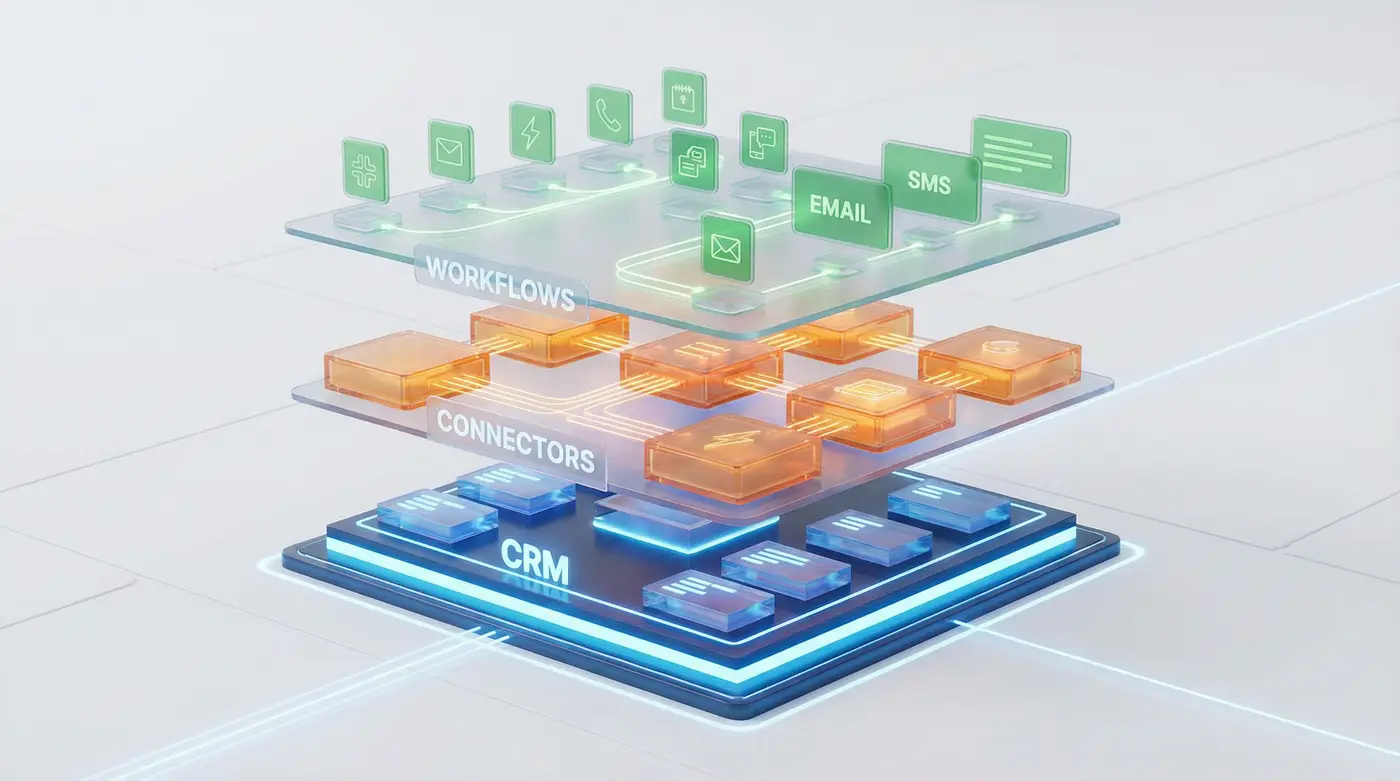
Building Your Layered Automation Stack
Successful business automation for small business requires a strategic, layered approach rather than implementing random tools. Here’s how to build a stack that grows with your business:
Layer 1: CRM Foundation
Your CRM serves as the central hub where all customer data converges. Choose a platform that offers native automation features and robust integration capabilities. This foundation should handle contact management, deal tracking, and basic workflow automation. Explore more about CRM integration in the advanced CRM integrations guide.
Layer 2: Workflow Connectors
Integration platforms like Zapier or Make connect your CRM to other business tools, creating automated data flows between systems. This layer eliminates manual data entry and ensures information consistency across platforms.
Layer 3: Channel-Specific Tools
Specialized tools for email marketing, social media management, SMS campaigns, and paid advertising plug into your automation stack to deliver targeted messages across preferred customer channels.
Layer 4: Analytics and Optimization
Reporting tools that aggregate data from multiple sources provide the insights needed to optimize automation performance and demonstrate ROI.
Real-World Automation Workflows That Drive Results
Understanding how these tools work together in practice is crucial for implementation success. Here are proven workflows that consistently deliver results:
Automated Lead Capture and Qualification
When a prospect fills out a form on your website, automation can immediately add them to your CRM, send a personalized welcome sequence, score the lead based on behavior and demographics, and notify your sales team if they meet qualification criteria. Learn more in the AI sales follow-up guide.
Appointment Scheduling and Follow-up
Integrate calendar scheduling tools with your CRM to automatically send confirmation emails, reminder sequences, and post-meeting follow-ups. This workflow ensures no prospects fall through the cracks while maintaining professional communication.
Multi-Channel Nurture Campaigns
Create sophisticated nurture sequences that combine email, SMS, and social media touchpoints based on prospect behavior and preferences. Advanced automation can adjust messaging frequency and channel mix based on engagement patterns.
Customer Onboarding and Retention
Automate the entire customer onboarding process from initial purchase through ongoing engagement. Include welcome sequences, educational content delivery, milestone celebrations, and renewal reminders.
Integration Best Practices for Maximum ROI
Successful automation depends on seamless integration between platforms. Focus on creating data flows that eliminate manual handoffs and provide complete visibility into customer journeys.
CRM to Website Integration
Connect your website forms directly to your CRM to capture leads instantly. Use tracking codes to monitor visitor behavior and trigger appropriate follow-up sequences based on pages visited and actions taken.
Calendar and Communication Sync
Integrate scheduling tools with your CRM and communication platforms to automate appointment confirmations, reminders, and follow-up sequences without manual intervention.
Financial System Connections
Link your CRM to accounting software to automate invoice generation, payment tracking, and customer lifecycle value calculations.
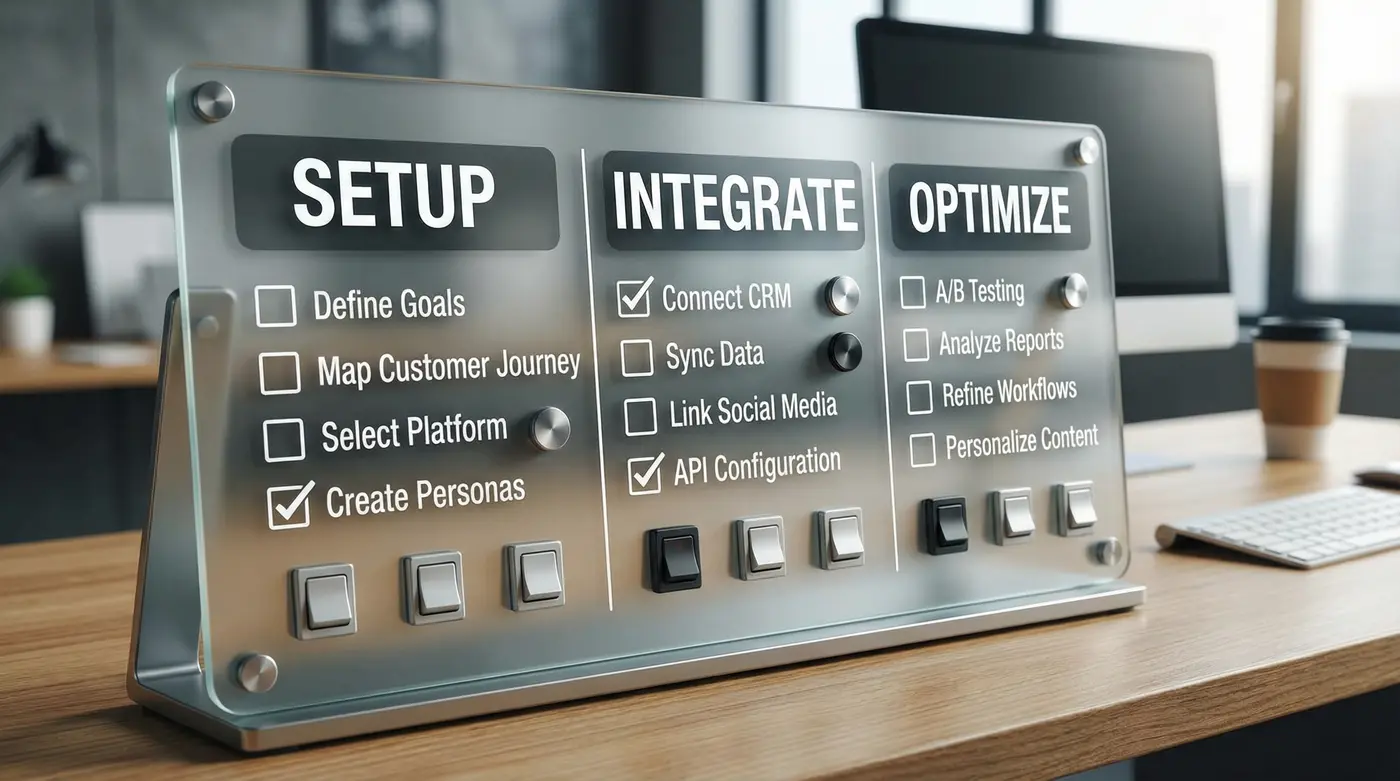
90-Day Implementation Roadmap
Implementing marketing automation successfully requires a structured approach. Here’s a proven 90-day roadmap:
Days 1-30: Foundation Setup
Select and configure your primary CRM platform. Import existing customer data and set up basic automation workflows for lead capture and welcome sequences. Focus on one or two high-impact automations that provide immediate value.
Days 31-60: Integration and Expansion
Implement workflow connectors to integrate your CRM with existing tools. Add email marketing automation and basic reporting dashboards. Begin testing more sophisticated workflows like lead scoring and segmentation.
Days 61-90: Optimization and Scaling
Analyze performance data to optimize existing workflows. Implement advanced features like behavioral triggers, dynamic content, and cross-channel campaigns. Document processes and train team members on system usage.
Overcoming Common Implementation Challenges
While automation offers tremendous benefits, successful implementation requires addressing several common challenges:
Maintaining Personalization at Scale
Use dynamic content fields, behavioral triggers, and segmentation to ensure automated messages remain relevant and personal. Avoid generic messaging that feels robotic or impersonal.
Preserving Human Connection
Build human touchpoints into automated workflows. Include opportunities for personal outreach, phone calls, and face-to-face interactions at key moments in the customer journey. Explore deeper automation strategies in the AI tools for funnels guide.
Staff Training and Adoption
Invest in comprehensive training programs that help team members understand not just how to use automation tools, but when and why specific workflows should be triggered.
Industry-Specific Automation Strategies
Different industries require tailored approaches to automation. Here’s how to adapt these strategies for specific sectors:
Luxury Real Estate
Focus on relationship-building automation that maintains the high-touch service expectations of luxury clients. Implement property alert systems, market update sequences, and anniversary reminders that demonstrate ongoing value.
Financial Services
Emphasize compliance-friendly automation that maintains required documentation and communication standards. Create educational sequences that build trust and demonstrate expertise over time.
High-Ticket Coaching
Develop nurture sequences that establish authority and trust before high-value sales conversations. Use automation to deliver valuable content while identifying the most qualified prospects for personal attention.
Measuring Success and ROI
Effective measurement is crucial for optimization and demonstrating value. Key metrics to track include:
Lead conversion rates at each stage of the funnel, time savings achieved through automation, customer acquisition costs and lifetime value, and revenue attribution across automated touchpoints.
Advanced platforms provide detailed analytics that show exactly how automation impacts business outcomes, enabling data-driven optimization decisions.
Choosing the Right Tools for Your Business
Tool selection should be based on your specific business model, technical capabilities, and growth objectives. Consider factors like integration capabilities with existing systems, scalability to support business growth, ease of use for your team, and total cost of ownership including implementation and training.
For most small businesses, starting with a comprehensive platform like HubSpot or Pulse CRM provides the best foundation for growth. As needs become more sophisticated, additional specialized tools can be integrated to enhance capabilities.
The Future of Small Business Automation
Marketing automation continues evolving with advances in artificial intelligence, predictive analytics, and cross-channel orchestration. Businesses that invest in robust automation foundations today will be best positioned to leverage these emerging capabilities.
The most successful implementations focus on creating systems that enhance rather than replace human relationships. Automation should free up time for strategic thinking and personal connection, not eliminate the human element that drives business success.
Ready to transform your business with marketing automation? Our team specializes in implementing done-for-you automation systems that deliver measurable results. Contact us today to discover how the right automation stack can double your growth in the next 12 months while freeing up your time to focus on what matters most.