How to Launch Profitable Online Ventures: Proven Models and Automation Strategies for Digital Entrepreneurs
The digital landscape has never been more promising for entrepreneurs seeking to build profitable online ventures. With global eCommerce projected to reach $5.5 trillion by 2027 and digital-first consumer behaviors becoming the norm, the opportunities for launching and scaling successful online businesses are unprecedented. Whether you’re a digital marketing agency looking to diversify revenue streams or an entrepreneur ready to capitalize on emerging market trends, understanding the proven models and automation strategies is crucial for success.
The convergence of advanced automation tools, AI-powered marketing platforms, and sophisticated customer relationship management systems has created an environment where even small teams can compete with enterprise-level businesses. This comprehensive guide explores the most effective approaches to identifying, launching, and scaling profitable online ventures that generate sustainable revenue growth.
Why Digital Ventures Are Thriving in Today’s Market
The shift toward digital-first business models has accelerated dramatically, driven by changing consumer preferences and technological advancements. Current market data reveals several compelling trends that make this the optimal time for launching online ventures:
Direct-to-consumer brands are attracting significant venture capital investment, with leading VC firms allocating substantial funds to digital-native companies that prioritize customer experience and data-driven growth. The average eCommerce gross profit margin of 33.7% demonstrates the financial viability of online business models compared to traditional retail operations.
Consumer behavior has fundamentally shifted toward convenience, personalization, and digital engagement. This transformation creates opportunities for businesses that can deliver exceptional online experiences while leveraging automation to scale efficiently. The rise of subscription-based models, membership communities, and digital product sales reflects consumers’ willingness to invest in ongoing relationships with brands they trust.

Most Profitable Online Business Models
eCommerce and Product-Based Ventures
Traditional eCommerce remains one of the most scalable and profitable online ventures, with multiple sub-models offering different entry points and growth trajectories. Dropshipping eliminates inventory risk while allowing entrepreneurs to test market demand quickly. Print-on-demand services enable custom product creation without upfront investment, particularly effective for content creators and niche communities.
Subscription box services represent a powerful model for recurring revenue generation. By curating products around specific interests or needs, businesses can build predictable income streams while fostering customer loyalty. The key to success lies in understanding your target audience deeply and delivering consistent value that justifies ongoing subscription costs.
Private label and white label products offer opportunities to build branded businesses with higher margins than traditional retail. This approach requires more initial investment but provides greater control over product quality, customer experience, and brand positioning.
Digital Content and Education Businesses
The digital education market continues expanding as professionals seek skills development and entrepreneurs look to monetize their expertise. Online courses, membership sites, and coaching programs offer high-margin opportunities with unlimited scalability potential.
Successful digital content businesses combine multiple revenue streams: course sales, membership subscriptions, one-on-one coaching, and affiliate marketing. This diversification creates stability and maximizes customer lifetime value through various touchpoints and engagement levels.
Podcasting and content creation platforms provide opportunities for audience building and monetization through sponsorships, affiliate marketing, and premium content offerings. The key is developing a consistent content strategy that attracts and retains a loyal audience willing to invest in your expertise.
Service-Based Digital Agencies
Digital marketing agencies, virtual assistance services, and specialized consulting firms represent scalable service businesses with recurring revenue potential. These models leverage expertise and relationships rather than physical products, offering higher margins and location independence.
The most successful service-based ventures focus on specific niches or industries, developing deep expertise that commands premium pricing. By combining human expertise with automation tools, these businesses can deliver exceptional results while maintaining healthy profit margins.
The Critical Role of Business Automation
Business automation serves as the foundation for scaling profitable online ventures efficiently. Modern automation platforms integrate customer relationship management, email marketing, sales funnel optimization, and customer service functions into cohesive systems that operate with minimal manual intervention.
Marketing automation enables businesses to nurture leads through sophisticated email sequences, behavioral triggers, and personalized content delivery. This approach increases conversion rates while reducing the time and resources required for manual follow-up and customer communication.
Fulfillment automation streamlines order processing, inventory management, and shipping logistics. For digital products, automation can handle instant delivery, access provisioning, and customer onboarding without human intervention. This scalability allows businesses to grow revenue without proportionally increasing operational costs.
Customer service automation through chatbots, knowledge bases, and automated support systems reduces response times while freeing human resources for complex problem-solving and relationship building. AI-powered tools can handle routine inquiries, process returns, and guide customers through common issues.
Essential Automation Tools and Platforms
Customer relationship management systems form the backbone of automated online businesses. These platforms track customer interactions, purchase history, and engagement patterns to enable personalized marketing and sales approaches. Integration with email marketing platforms creates seamless lead nurturing workflows. Insights from AI CRM integrations further enhance these capabilities.
Email marketing automation platforms enable sophisticated drip campaigns, behavioral triggers, and segmentation strategies. Email marketing automation consistently delivers the highest return on investment among digital marketing channels, making it essential for sustainable business growth.
Analytics and tracking tools provide insights into customer behavior, conversion patterns, and revenue attribution. This data enables continuous optimization of marketing campaigns, product offerings, and customer experience elements.
Selecting and Validating Your Niche
Successful online ventures begin with thorough market research and niche validation. The most profitable opportunities exist at the intersection of market demand, personal expertise, and competitive differentiation. This analysis requires examining search volume data, competitor pricing strategies, and customer feedback patterns.
Audience targeting involves creating detailed customer personas based on demographics, psychographics, and behavioral patterns. Understanding your ideal customer’s pain points, preferences, and purchasing behaviors enables more effective product development and marketing strategies.
Competitive analysis reveals market gaps and positioning opportunities. Rather than competing directly with established players, successful ventures often identify underserved segments or innovative approaches to existing problems. This differentiation becomes crucial for marketing effectiveness and premium pricing strategies.
Market validation through minimum viable products, landing page tests, and customer interviews reduces launch risk while providing valuable feedback for product refinement. This iterative approach allows entrepreneurs to adjust their offerings based on real market feedback before significant investment.
Building Sustainable Recurring Revenue Streams
Recurring revenue models provide predictable income streams that increase business valuation and reduce customer acquisition pressure. Subscription services, membership sites, and retainer-based consulting arrangements create ongoing customer relationships that compound over time.
Membership communities combine content delivery with peer interaction, creating additional value that justifies ongoing subscription fees. These platforms often include exclusive content, live events, networking opportunities, and direct access to expertise.
Software as a Service (SaaS) models offer unlimited scalability potential with high switching costs once customers integrate the platform into their workflows. Even simple tools that solve specific problems can generate substantial recurring revenue when positioned effectively.
Bundled services and product packages increase average order value while providing comprehensive solutions to customer needs. This approach often results in higher customer satisfaction and reduced churn rates compared to single-product offerings.
Maximizing Customer Lifetime Value
Customer lifetime value optimization involves strategic upselling, cross-selling, and retention initiatives that extend customer relationships and increase total revenue per customer. This approach proves more cost-effective than continuous new customer acquisition.
Retention strategies include loyalty programs, exclusive offers, and personalized communication that maintains engagement beyond initial purchases. Regular value delivery through content, support, and product improvements strengthens customer relationships and reduces churn.
Upselling and cross-selling opportunities emerge through careful analysis of customer behavior and purchase patterns. Automated recommendation systems and targeted offers can significantly increase revenue without proportional increases in marketing costs.
Multi-Channel Marketing for Maximum Reach
Effective online ventures leverage multiple marketing channels to maximize reach and reduce dependence on single traffic sources. This diversification provides stability and enables testing of different customer acquisition approaches.
Paid advertising across Facebook, Google, and LinkedIn platforms offers immediate reach and precise targeting capabilities. Each platform serves different customer journey stages and demographic segments, requiring tailored approaches and creative strategies.
Content marketing and search engine optimization provide long-term organic traffic growth while establishing authority and trust. This approach requires consistent effort but generates compound returns over time through improved search rankings and content library expansion.
Influencer partnerships and affiliate marketing extend reach through established audiences and credible endorsements. These relationships often provide higher conversion rates than traditional advertising while building brand awareness and social proof.
Scaling online business requires integration between marketing channels and customer relationship management systems. This coordination ensures consistent messaging and enables sophisticated attribution analysis for optimization purposes. Valuable insights can be found in the automation for conversion improvement guide.
Funding and Investment Considerations
Understanding investor perspectives on digital ventures provides valuable insights for business planning and growth strategies. Venture capital firms increasingly focus on businesses with strong unit economics, clear paths to profitability, and scalable technology platforms.
Key metrics that attract investor attention include customer acquisition costs, lifetime value ratios, monthly recurring revenue growth, and market size potential. Businesses demonstrating these fundamentals often access growth capital for expansion and market penetration.
Bootstrap-friendly business models enable growth without external funding through reinvestment of profits and organic expansion. This approach maintains founder control while building sustainable operations that can scale based on market demand.
Revenue-based financing and alternative funding sources provide capital access without equity dilution. These options work particularly well for businesses with predictable revenue streams and clear growth trajectories.
Actionable Steps for Launch and Growth
Successful venture launches follow systematic approaches that minimize risk while maximizing learning opportunities. Begin with comprehensive market research and competitive analysis to identify viable opportunities and positioning strategies.
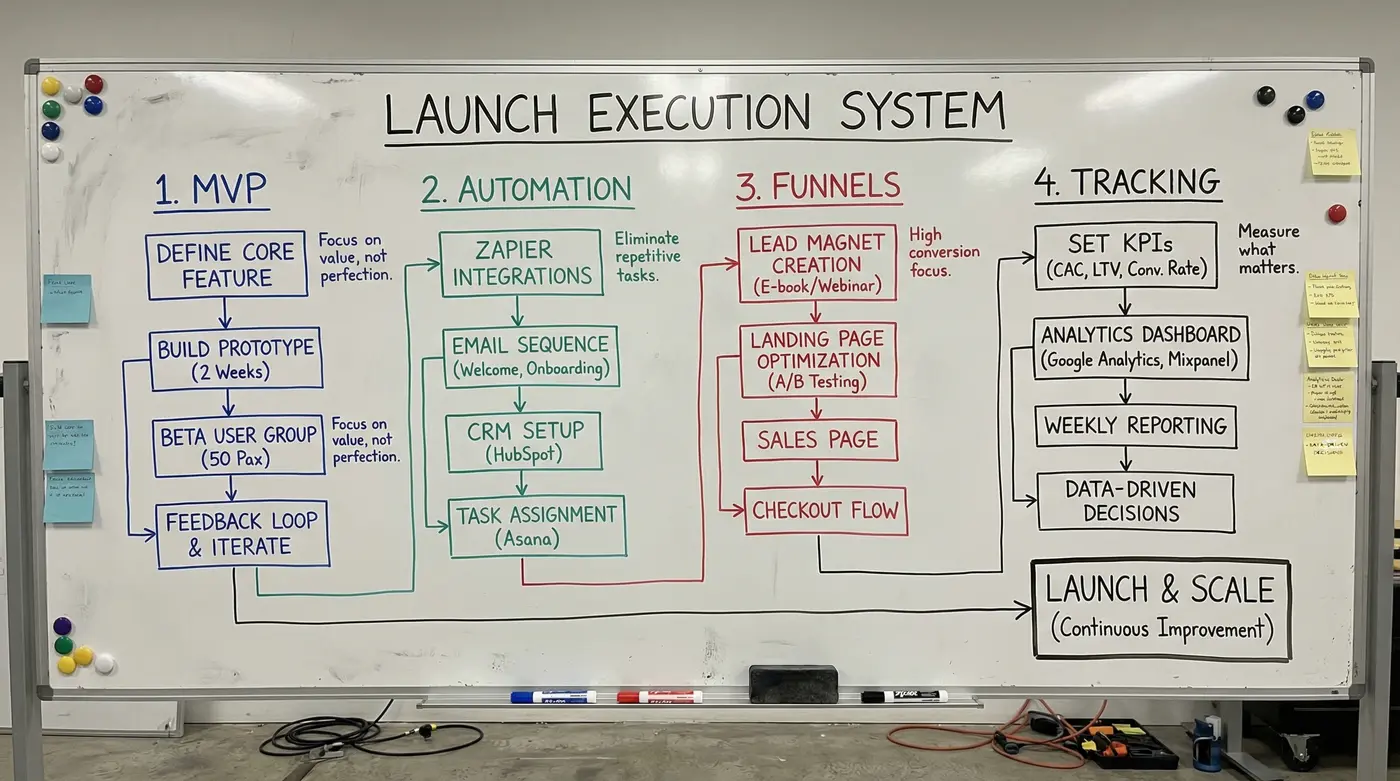
Develop minimum viable products that test core value propositions without significant investment. This iterative approach enables rapid feedback incorporation and reduces development costs while validating market demand.
Build automated marketing and sales systems before launch to ensure scalable customer acquisition and conversion processes. Email marketing automation, customer relationship management, and analytics tracking form the foundation for sustainable growth.
Create detailed launch plans that coordinate product availability, marketing campaigns, and customer support systems. This preparation prevents common launch issues and enables immediate response to customer needs and market feedback.
Essential Technology Stack
Modern online ventures require integrated technology platforms that handle eCommerce, marketing automation, customer management, and analytics functions. Selecting compatible tools that integrate seamlessly reduces operational complexity and improves efficiency.
Website platforms should prioritize speed, mobile optimization, and conversion optimization features. These technical foundations directly impact search engine rankings, user experience, and sales conversion rates.
Payment processing systems must provide security, reliability, and global accessibility while minimizing transaction costs. Multiple payment options reduce friction and accommodate diverse customer preferences.
Analytics and tracking systems enable data-driven decision making through detailed insights into customer behavior, marketing performance, and operational efficiency. This information guides optimization efforts and strategic planning.
Success Stories and Case Studies
Examining successful online ventures reveals common patterns and strategies that contribute to sustainable growth. Many profitable businesses start with focused niche markets before expanding into broader categories or related products.
Digital-first brands that prioritize customer experience and data-driven optimization often achieve rapid growth and high valuations. These companies leverage automation and personalization to create competitive advantages that traditional businesses struggle to match.
Service-based businesses that successfully transition to productized offerings or recurring revenue models demonstrate the power of evolution and adaptation in digital markets. This transformation often involves systematizing expertise and creating scalable delivery mechanisms.
Multi-channel approaches that combine content marketing, paid advertising, and partnership development provide sustainable customer acquisition and brand building. The most successful ventures treat marketing as an integrated system rather than isolated tactics. Additional inspiration can be drawn from how automation is transforming operations in the AI back office automation guide.
Future-Proofing Your Online Venture
Building sustainable online businesses requires attention to emerging trends and technological developments that could impact customer behavior and competitive landscapes. Artificial intelligence, voice commerce, and augmented reality represent significant opportunities for early adopters.
Sustainability and social responsibility increasingly influence consumer purchasing decisions, creating opportunities for businesses that align with these values. Environmental consciousness and ethical business practices often command premium pricing and customer loyalty.
Global market expansion becomes more accessible through digital platforms and automated translation services. This reach enables businesses to access larger markets while diversifying revenue sources and reducing local market dependence.
Continuous learning and adaptation ensure long-term success in rapidly evolving digital markets. Successful entrepreneurs invest in education, networking, and experimentation to stay ahead of trends and maintain competitive advantages.
Taking Action on Your Profitable Online Venture
The opportunities for launching profitable online ventures continue expanding as technology advances and consumer behaviors evolve toward digital-first experiences. Success requires combining proven business models with modern automation tools and sophisticated marketing strategies.
Whether you choose eCommerce, digital education, or service-based models, the key lies in thorough planning, systematic execution, and continuous optimization based on market feedback. The businesses that thrive focus on delivering exceptional customer value while building scalable systems that support sustainable growth.
Ready to transform your business idea into a profitable online venture? Our team specializes in helping growth-focused businesses develop and implement comprehensive digital strategies that drive measurable results. From automated sales funnels to multi-channel marketing campaigns, we provide the expertise and support needed to achieve your ambitious growth goals.
Contact us today to discuss how we can help you build and scale your profitable online venture using proven automation strategies and marketing systems designed for sustainable growth.